Most Auspicious Day for Baby Birth in 2019
F or Xu Meiru, 38, the thought of having a second kid is exhausting. Her days typically begin at 5am, don't end until 11pm, and are filled with shuttling her ix-year-erstwhile son to school, helping him with his homework, preparing meals and running an online clothing business.
"It's hard to find time even to sleep for a few minutes in a chair," she says, sitting in a McDonald'due south while her son plays a game on a phone, the detritus of a Happy Meal in forepart of him.
Most tiring is the constant worry over whether she is doing enough to help him become ahead. He goes to music lessons, taekwondo classes and extra English tutoring. She spends the beginning week of every summer and winter break helping him prepare for the adjacent term. Sometimes her son's workload is so heavy that Xu does his assignments for him, using her left hand to brand her writing more childlike.
"There are too many children and the competition is too high. If you lot don't practise well in schoolhouse yous tin't get into a expert university, and so perchance you tin can't get a proficient chore in the future," she says. She is visibly anxious when discussing the prospect of a second child, something that until three years ago would have been forbidden nether Chinese police force. "If nosotros were to take another child, I'm agape I wouldn't have the energy for them," Xu says.
Faced with a population that is shrinking and ageing, Chinese policymakers are attempting to engineer a baby boom after more than 3 decades of a Malthusian family planning regime improve-known as the ane-kid policy. Central policy planners have loosened restrictions on family sizes, and now all married couples can have 2 children. There is talk of the limits existence dropped altogether, and amid aggressive propaganda drives, local officials are experimenting with subsidies and incentives for parents.
But these efforts announced to be too little too late. Birthrates have fallen and are likely to go along to drib every bit parents like Xu decide against having more children. More immature women are pushing back against state propaganda and family unit pressure, while improving instruction standards and income levels have delayed marriage and childbirth. Moreover, decades of the one-child policy have made single-child households the norm, experts say.
"China should accept stopped the policy 28 years ago. At present it's besides tardily," says Yi Fuxian, a senior scientist at the Academy of Wisconsin in Madison and a longtime critic of the family planning policies.
Demographers warn that People's republic of china'south population will begin to shrink in the next decade, potentially derailing the world's second-largest economy, with a far-reaching global impact. China'southward birthrate last year was at its lowest since the founding of the People'southward Commonwealth in 1949, with fifteen.23 million births, dramatically lower than the 21-23 1000000 officials had expected.
Past 2050 every bit much as a third of the country'southward population will exist fabricated upward of people over the age of sixty, putting astringent strain on country services and the children who bear the brunt of caring for elderly relatives.
Nowhere is this trend more obvious than in China'southward rust chugalug, the northward-eastern region meliorate-known equally Dongbei which has the lowest birthrates in the country, the result of strict enforcement of family planning limits and the region'due south early development. For residents in Shenyang, the largest urban center in Dongbei, in central Liaoning province, information technology's obvious why few families are willing to have more children – the economy.
Rich in resources such equally iron ore and coal, Dongbei was at the heart of the country's heavy industry betwixt the 1950s and 1970s. During the reform era, industries moved s to the coastal regions, and the state-run companies that employed most Dongbei workers have struggled, causing a mass exodus to other parts of Red china.
"Shanghai, Guangzhou, all these cities are moving frontwards, but Shenyang has stayed in place. All the high-rises don't alter anything," says Zhang Yang, 36, who works in purchasing for a local state-endemic company. "Few people are having babies because the economy is and then bad."
During Dongbei'south heyday, Shenyang was the region's economic hub, with blocks of factories lining its main street. At present those buildings have been replaced by high-rise apartments, banks and hotels while the factories have been relocated to a suburb outside the metropolis. The new economic zone, the new home for these factories, is quiet.
Workers in grayness jumpsuits walk forth the route just before apex. A sign on a taxi calls on Shenyang residents "to fight" for the rejuvenation of their metropolis. Neighbourhoods in the former industrial sector are being torn downward to brand style for new buildings.
The birthrate here is especially low, at 8.79 per 1,000 women, compared with the national boilerplate of 12.43 in 2017. The urban center is ageing quickly – a quarter of residents were above the age of lx in 2017, and local population experts believe the city volition soon overtake Shanghai to have People's republic of china's oldest populace.
Dongbei's struggling economy is the master reason Zhang and his married woman accept decided not to have some other kid. He has not had a wage increment in 3 years. When his son goes to kindergarten in a few years, he expects about half of his income volition go toward his schooling and extra classes and activities.
His hope is that his son volition go to university in the due south of Red china and pursue a career and life there. "It'due south not that I'grand worried most Liaoning'southward future. I have no hope for it at all," Zhang says.
Birthrates in Dongbei, home to nigh 109 million people, have fallen steeply. The average number of children per woman was 0.ix in 2000 and 0.56 in 2015, according to Yi. That means the next generation will exist a quarter of the size of the last one.

Terminal summer, Liaoning released a Population Development Plan, vowing to raise the province'due south birthrate past "working hard to create good public opinion about having two children". Officials promised to explore subsidies for families with two children, encourage employers to offer more services for families, and back up women returning to piece of work after giving birth.
While parents in Shenyang say they have noticed an increase in nursing facilities at shopping centres and other public spaces, they have yet to run into whatever substantial support from the government. "For all these years, there oasis't been any policies to help. Government pledges like these are like thunder without raindrops. This is similar lying to a little kid," Zhang says.
Dongbei offers an instance of what is to come for the remainder of the country. As an early on industrial hub, the province urbanised quickly, with incomes and education levels several years ahead of the national average – factors that human activity equally natural constraints on the birthrate, according to experts. Equally other parts of the country get through similar stages of urbanisation and economic growth, they are going through comparable declines.
"This is non just Dongbei but the whole state. Y'all know what they say in economic science: development is the best birth control," says Song Limin of the Population Enquiry Institute at Liaoning University.
Researchers believe the national rate of births could fall further. Final twelvemonth's depression rate surprised many. Liang Jianzhang, a professor of economics at Peking University, says he and his colleagues had expected births to peak in 2017 and begin falling after 2018.
"That peak apparently arrived in 2016, with births dropping ever since … What we tin can look now is that the number of newborns will go along to shrink rapidly in 2019 and beyond," he wrote in an editorial in January.
"It can be said with certainty that even though 2018 saw a low number of births, that number will not be surpassed for the next 100 years. China will never come across more than fifteen million newborns in the future," he predicted.
Local governments across China are struggling to reverse the declines with subsidies, propaganda initiatives and new regulations on workplace leave. In Xiantao, Hubei province, hospitals accept offered to embrace the costs of childbirth as well as requite a 500 yuan (£60) subsidy for the first child and another 700 for the 2d. In Changsha, in southern China, an advertising campaign last year listed "one,001 reasons to have a babe". Between 2016 and 2017, about all provinces extended motherhood get out.
Some worry that such measures will turn coercive, with the authorities deploying an extensive family planning apparatus to encourage births. Officials in one case restricted population size through heavy fines, forced abortions and sterilisations.
"There is a danger that the government sees that what it has tried and so far has failed, and it has to become more coercive. At that place's a long history in population planning of extreme coercion. There is no question that the government could adopt coercive measures," says Leta Hong Fincher, author of Betraying Large Brother: The Feminist Enkindling in China.
Critics say that less invasive but all the same punitive measures would probably emerge gradually at local level under the guise of other causes such as preventing sexual practice-selective abortions. Several provinces have banned abortions after 14 weeks, and Jiangxi province in the s requires the signature of iii medical professionals before the procedure can be performed. More provinces have put in place obstacles to getting divorces, including a test or mandated cooling-off catamenia.
Government language has alarmed people. Last yr an commodity in the land-run People'south Daily said: "The nascency of a infant is not only a matter of the family itself merely also a state affair." In August, an economics professor from Nanjing Academy wrote an editorial proposing a "nascence fund" that citizens contribute to, and so cash in when they have children. Those who don't have children would become the money when they retire.
1 internet user wrote: "When you don't desire children, you force people to get sterilised. When y'all desire more, you lot urge us to give birth. What do you lot recollect I am?"
For now efforts have focused on cajoling women into take more than children for the expert of the country. The All China Women's Federation, a authorities-affiliated organisation, has been running a "beautiful families" campaign, praising women who serve as master caretakers of their parents and children.
"The party state sees the declining population every bit a real problem, and it'south women'due south duty to respond to that," says Jane Golley, an associate professor at Australian National University, who focuses on the Chinese economic system and labour economics. "It'southward a new era of control over women'due south reproductive choices."
Yet more women are resisting regime and societal pressure, and officials are waking up to their concerns. Mainland china'southward education and human resource ministries take ordered employers to stop request female person applicants about their marital status and plans for children, a common practice.
Ye Liu, a sociologist and lecturer in international development at King's College London, has been interviewing Chinese women in their late 30s. When the 2-child policy was introduced in 2016, most of her respondents were in what should take been the "second leap" of their careers, with the raising of their first child already backside them, with seniority and more bargaining power at work. Many were devastated rather than overjoyed by the new policy.
"They are forever a liability for their employers because they might have a second child," Ye says. A tertiary of her respondents said they did not want another child, preferring to focus on their career. "They feel like they were experiments of the land. They were the experiments [under the ane-child policy] and now they are another experiment. They feel similar they are forever being used past the state laboratory," Ye says.
Public resentment is one reason why policymakers did not stop the policy sooner. Co-ordinate to Yi Fuxian, the Wisconsin bookish, People's republic of china could take completely scrapped population controls in 1980 and growth would have moderated naturally. But family planners relied on overinflated school enrolment and overreported births past hospitals, individuals and local governments. "Why did we follow such a wrong policy for so long? The Chinese regime doesn't want to admit it'due south wrong. It says the policy was correct just at present is the time to alter. If it just says the policy was wrong, the public volition become aroused," he says.
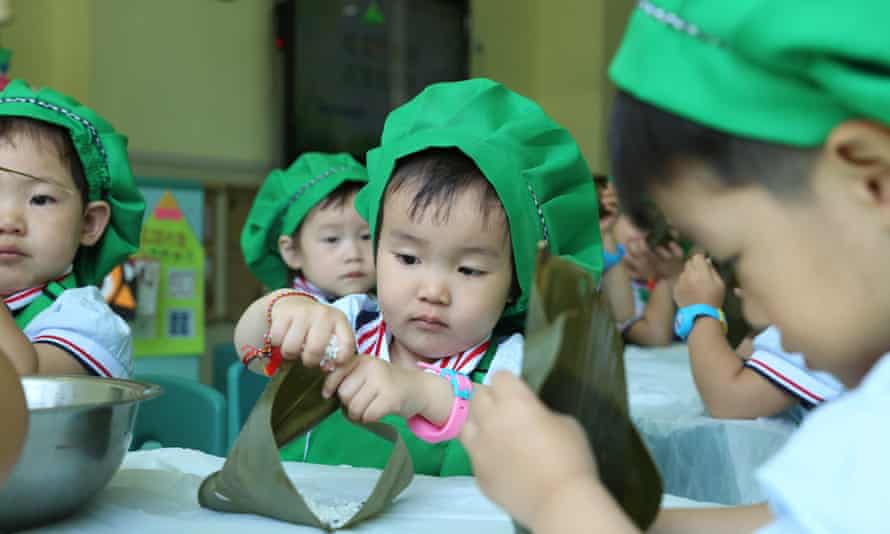
Living in a city with some of the lowest birthrates, Shenyang residents appear surprisingly focused on children. Groups of parents and grandparents tote small-scale children around shopping centres filled with playgrounds and stores advertising toys and educational games. Parents depict the range of activities they can choose from: sensory classes for babies, infant swimming classes, taekwondo, Chinese calligraphy, English language tutoring or drawing.
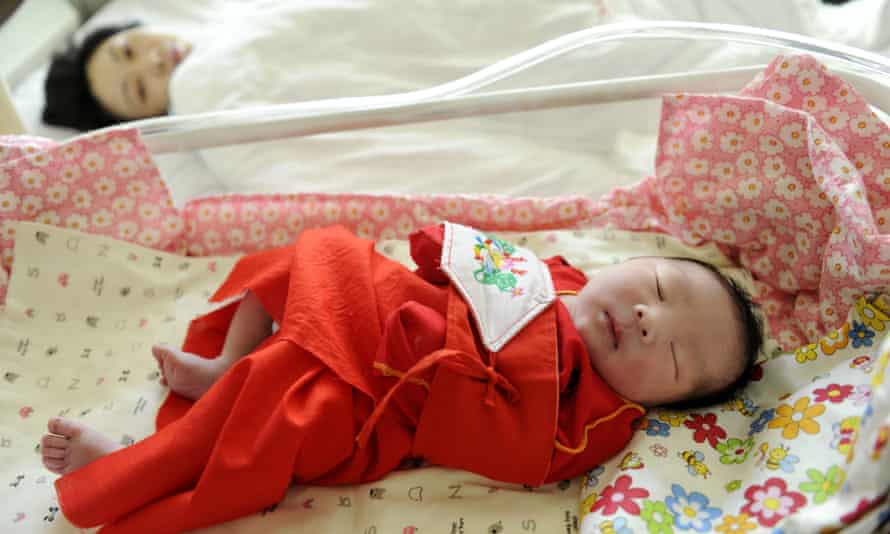
The Dunnan True Honey Heart in central Shenyang offers high-stop convalescence for mothers recuperating after childbirth, a Chinese tradition known as "sitting the month".This is role of a focus on "quality over quantity", where families invest all their resources into 1 kid, says Wang Libo, an expert on population at Shenyang Normal University. Of the 500 clients the centre received terminal year, only three have had a second child, as far as they know. But they expect business to be brisk this twelvemonth: the year of the pig in the Chinese calendar is associated with luck and wealth and thus an auspicious year to be born.
For many families, the pressure to help their kid compete is the principal reason for having just the ane. Xu sends her son to extra tutoring and lessons only worries that he is under too much pressure. She has read articles about children, pushed too hard by their parents, who have killed themselves or run away from home. She tries to find a place in his schedule for some free fourth dimension, and buys him all the comics and books that he wants. Still, when he performs a little worse on a test or assignment, she grows anxious once again. "You tin can't help just wonder: what if I pushed him to study for just x more minutes?"
Most Auspicious Day for Baby Birth in 2019
Source: https://www.theguardian.com/world/2019/mar/02/china-population-control-two-child-policy
0 Response to "Most Auspicious Day for Baby Birth in 2019"
Post a Comment