Printable Funny Fractions and Ford Circles Humberphile

Ford circles for q from 1 to twenty. Circles with q ≤ 10 are labelled as p / q and color-coded according to q. Each circumvolve is tangent to the base line and its neighboring circles. Irreducible fractions with the same denominator have circles of the same size.
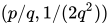
In mathematics, a Ford circle is a circle with center at and radius where is an irreducible fraction, i.due east. and are coprime integers. Each Ford circle is tangent to the horizontal axis and any two Ford circles are either tangent or disjoint from each other.[i]


History [edit]
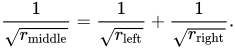
Ford circles are a special instance of mutually tangent circles; the base line can be thought of equally a circle with space radius. Systems of mutually tangent circles were studied by Apollonius of Perga, after whom the problem of Apollonius and the Apollonian gasket are named.[ii] In the 17th century René Descartes discovered Descartes' theorem, a relationship between the reciprocals of the radii of mutually tangent circles.[two]
Ford circles besides appear in the Sangaku (geometrical puzzles) of Japanese mathematics. A typical trouble, which is presented on an 1824 tablet in the Gunma Prefecture, covers the relationship of iii touching circles with a common tangent. Given the size of the two outer big circles, what is the size of the small circle betwixt them? The answer is equivalent to a Ford circumvolve:[3]
Ford circles are named afterward the American mathematician Lester R. Ford, Sr., who wrote nearly them in 1938.[one]
Backdrop [edit]

Comparison of Ford circles and a Farey diagram with round arcs for n from 1 to 9. Annotation that each arc intersects its corresponding circles at right angles. In the SVG image, hover over a circle or curve to highlight it and its terms.
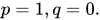
The Ford circle associated with the fraction is denoted by or There is a Ford circle associated with every rational number. In add-on, the line is counted as a Ford circle – information technology can be idea of every bit the Ford circle associated with infinity, which is the case
![C[p/q]](https://wikimedia.org/api/rest_v1/media/math/render/svg/b5c490fee44782cc1e23014c6db7076ae507fedc)
![C[p,q].](https://wikimedia.org/api/rest_v1/media/math/render/svg/7a097d9ed56d358d94eed7a537d87b6eedc4aa9a)

Ii different Ford circles are either disjoint or tangent to i another. No two interiors of Ford circles intersect, even though in that location is a Ford circumvolve tangent to the x-centrality at each bespeak on information technology with rational coordinates. If is between 0 and i, the Ford circles that are tangent to tin can be described variously as
- the circles where [1]
- the circles associated with the fractions that are the neighbors of in some Farey sequence,[one] or
- the circles where is the next larger or the next smaller antecedent to in the Stern–Brocot tree or where is the next larger or next smaller ancestor to .[1]
![C[r/s]](https://wikimedia.org/api/rest_v1/media/math/render/svg/b4ac31c571b07baeda9d360eff7f934e1f0f0005)


If and are two tangent Ford circles, so the circumvolve through and (the 10-coordinates of the centers of the Ford circles) and that is perpendicular to the -axis (whose center is on the x-centrality) as well passes through the point where the two circles are tangent to 1 another.


Ford circles tin can also exist thought of as curves in the complex airplane. The modular grouping of transformations of the complex aeroplane maps Ford circles to other Ford circles.[ane]
Ford circles are a sub-set of the circles in the Apollonian gasket generated by the lines and and the circle [4]

![C[0/1].](https://wikimedia.org/api/rest_v1/media/math/render/svg/9e1db2266797dd774c771aeb1f23be80efa58909)
By interpreting the upper half of the complex plane as a model of the hyperbolic plane (the Poincaré half-plane model), Ford circles can exist interpreted as horocycles. In hyperbolic geometry whatever two horocycles are coinciding. When these horocycles are circumscribed by apeirogons they tile the hyperbolic plane with an order-3 apeirogonal tiling.
Total area of Ford circles [edit]
There is a link between the surface area of Ford circles, Euler's totient part the Riemann zeta role and Apéry's constant [5] Every bit no 2 Ford circles intersect, it follows immediately that the total surface area of the Ford circles


![{\displaystyle \left\{C[p,q]:0<{\frac {p}{q}}\leq 1\right\}}](https://wikimedia.org/api/rest_v1/media/math/return/svg/e886f3e9504f285e6bcded563ec21caaf79f0672)
is less than i. In fact the full area of these Ford circles is given by a convergent sum, which can exist evaluated. From the definition, the surface area is
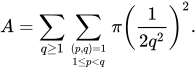
Simplifying this expression gives

where the last equality reflects the Dirichlet generating function for Euler's totient office Since this finally becomes

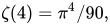
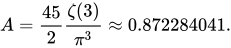
Notation that as a affair of convention, the previous calculations excluded the circle of radius respective to the fraction . Information technology includes the complete circumvolve for , half of which lies outside the unit interval, hence the sum is withal the fraction of the unit square covered by Ford circles.


Ford spheres (3D) [edit]

Ford spheres higher up the complex domain
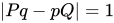
The concept of Ford circles tin be generalized from the rational numbers to the Gaussian rationals, giving Ford spheres. In this construction, the complex numbers are embedded as a plane in a three-dimensional Euclidean space, and for each Gaussian rational betoken in this plane one constructs a sphere tangent to the plane at that point. For a Gaussian rational represented in everyman terms as , the diameter of this sphere should exist where represents the complex conjugate of . The resulting spheres are tangent for pairs of Gaussian rationals and with , and otherwise they do not intersect each other.[6] [7]


See also [edit]
- Apollonian gasket – a fractal with infinite mutually tangential circles in a circle instead of on a line
- Steiner chain
- Pappus chain
References [edit]
- ^ a b c d e f Ford, L. R. (1938), "Fractions", The American Mathematical Monthly, 45 (9): 586–601, doi:10.2307/2302799, JSTOR 2302799, MR 1524411 .
- ^ a b Coxeter, H. S. Yard. (1968), "The problem of Apollonius", The American Mathematical Monthly, 75: 5–15, doi:10.2307/2315097, MR 0230204 .
- ^ Fukagawa, Hidetosi; Pedoe, Dan (1989), Japanese temple geometry problems, Winnipeg, MB: Charles Babbage Inquiry Centre, ISBN0-919611-21-4, MR 1044556 .
- ^ Graham, Ronald L.; Lagarias, Jeffrey C.; Mallows, Colin L.; Wilks, Allan R.; Yan, Catherine H. (2003), "Apollonian circle packings: number theory", Periodical of Number Theory, 100 (ane): 1–45, arXiv:math.NT/0009113, doi:10.1016/S0022-314X(03)00015-5, MR 1971245 .
- ^ Marszalek, Wieslaw (2012), "Circuits with oscillatory hierarchical Farey sequences and fractal properties", Circuits, Systems and Signal Processing, 31 (four): 1279–1296, doi:10.1007/s00034-012-9392-3 .
- ^ Pickover, Clifford A. (2001), "Chapter 103. Dazzler and Gaussian Rational Numbers", Wonders of Numbers: Adventures in Mathematics, Mind, and Meaning, Oxford University Printing, pp. 243–246, ISBN9780195348002 .
- ^ Northshield, Sam (2015), Ford Circles and Spheres, arXiv:1503.00813, Bibcode:2015arXiv150300813N .
External links [edit]
- Ford's Touching Circles at cut-the-knot
- Weisstein, Eric W. "Ford Circle". MathWorld.
- Bonahon, Francis. "Funny Fractions and Ford Circles" (YouTube video). Brady Haran. Archived from the original on 2021-12-21. Retrieved 9 June 2015.
Source: https://en.wikipedia.org/wiki/Ford_circle
0 Response to "Printable Funny Fractions and Ford Circles Humberphile"
Post a Comment